
The Gloucester Sea Serpent
The harbor visitor that challenged naturalists in 1817
| Also known as | Gloucester Sea Serpent |
|---|---|
| Region | Gloucester and Cape Ann, Massachusetts (USA) |
| First sighting | August 1817 |
| Type of creature | Legendary sea serpent |
| Danger level | ☾☾☾☾☾ |
A shadow among the boats
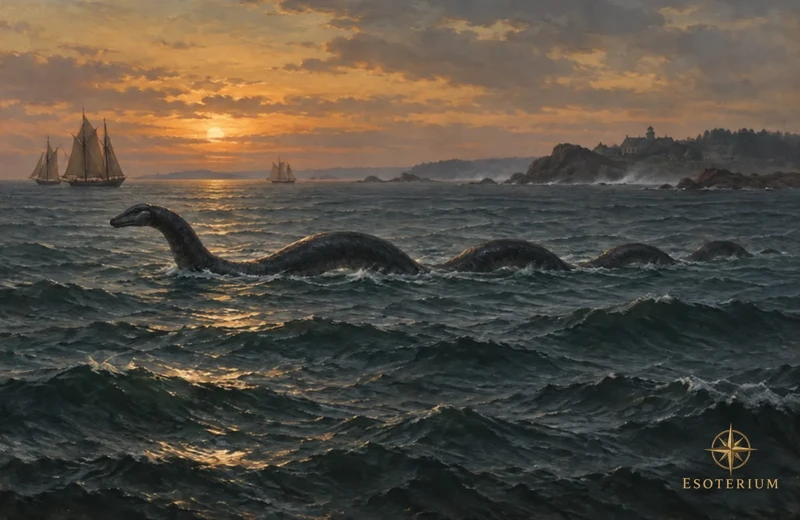
Imagine watching a harbor and realizing that what looked like a succession of waves seems to move as one body. That is the unease evoked by the Gloucester sea serpent: a head above the water and an uncertain length trailing behind. In August 1817, dozens of residents of this Massachusetts town claimed to have seen an enormous creature offshore. The Cape Ann Museum keeps the episode alive in local memory. Source: Cape Ann Museum.

What the witnesses said
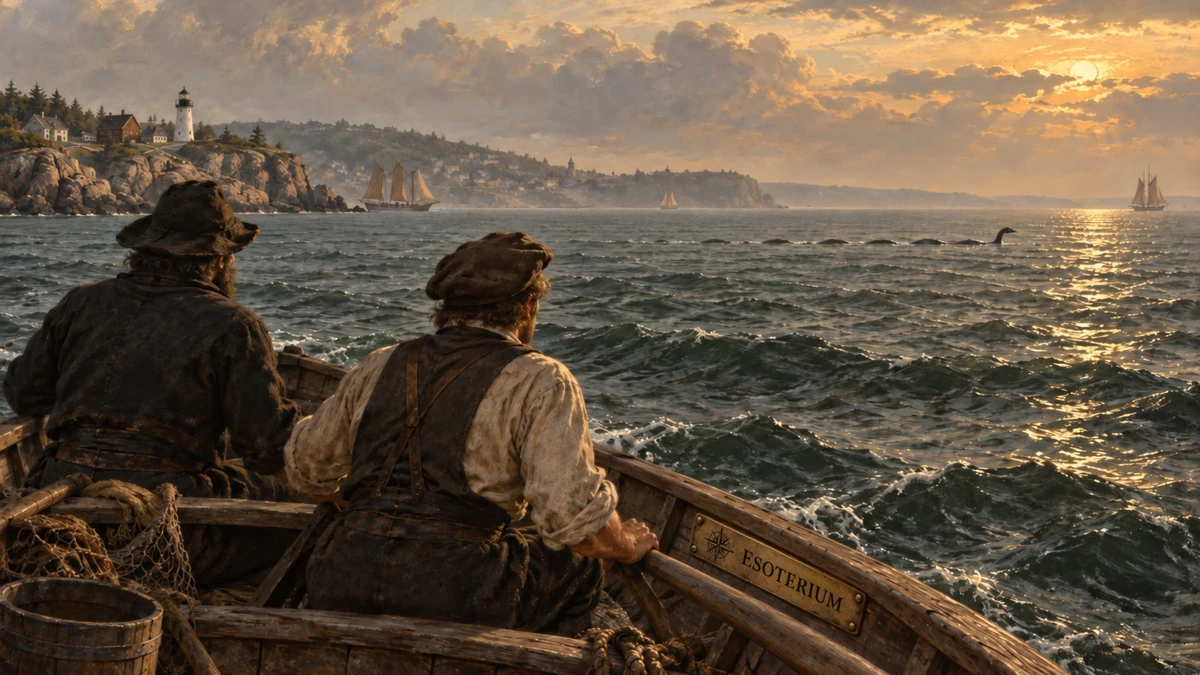
Testimony collected by the Linnaean Society of New England did not describe one consistent animal. Amos Story compared its head to a sea turtle’s and reported no humps on its back. Solomon Allen described a dark shape with numerous visible sections and estimated a length of eighty to ninety feet, roughly 24–27 metres: an estimate, not a measurement. Lonson Nash disputed both his account of its movement and the number of humps. These statements were reproduced in The Great Sea-Serpent by A. C. Oudemans (1892), a historical work supporting the existence of such creatures that calls for critical reading.
A monster enters the archive
The case left something more lasting than a wake: documents and pictures. Royal Museums Greenwich holds a print whose title refers to the reported sighting of 23 August 1817. The print establishes that the story circulated and was illustrated; it cannot verify the creature’s anatomy. An archival record and biological evidence have different kinds of value. View the print at Royal Museums Greenwich.
What might have been in the water?
Oarfish are among the real animals associated with sea-serpent legends, according to London’s Natural History Museum. That does not identify the Gloucester visitor. Assessing such accounts also requires considering distance, waves and the difficulty of distinguishing one continuous body from several aligned shapes. These are observational limitations, not a demonstrated solution. What remains is a collection of accounts that sustained a legend, without a confirmed species of giant serpent behind it. The harbor falls quiet again; the records remain there to be read.